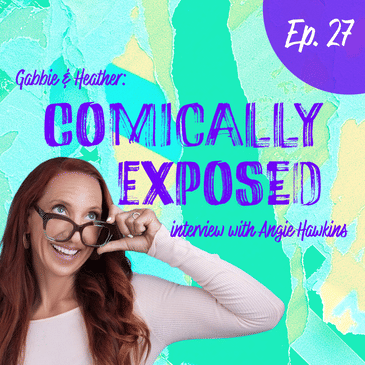
Episode 27 Transcript:
[🎵 Intro Music]
Heather: Welcome, listeners, to Comically Exposed, Episode 27. I'm Heather Nye, and my co host is...
Gabbie: Gabbie Blachman.
Heather: We are very excited to introduce our guest. Um, I met this person at Second, in a Second City class. She has published her first memoir, Running in Slippers, great title by the way, in 2022, and recently released an audiobook version, which she also narrates. Wow. Um, anyway, her book is a raw retelling that starts with a breakup and loss of a parent to um, a big move from Chicago to Hawaii where she finds her voice through her struggles with boundaries, mental health, and trauma. She's also an avid thrill seeker. Fingernail artist and has run 16 marathons. Give a warm welcome to our guest, Angie Hawkins. Yay.
Angie: Hey ladies. Thank you for having me.
Gabbie: Ah, thank you for being here. Um, I missed that part on the written introduction. I'm sorry, was that 16 marathons?
Angie: Yes, I used to be a very avid runner, which actually ties into my mental health.
Gabbie: Really? Okay, then go. Yeah. Let's just start. We're starting. We're going.
Heather: We're going right into it.
Angie: So, how I started running marathons was, um, I started running, I think it like stemmed from my anxieties. It was a way to calm my anxiety. But then it kind of turned into a destructive habit because I became an overexerciser. And the reason I started running marathons is because your training runs are longer distances.
So once I would get to that, like, runner's high, so to speak, I would just totally dissociate. And I loved that. So that's how I got into long distance running. So it was actually a very negative thing. But certain addictions, such as like over exercising or over working, those are actually viewed positively by society.
So it's like reinforced, because it's like, Oh, you did really well on this race. And again, like that external validation. So it's like actually very rewarding. Whereas if someone were addicted to drugs, you wouldn't be. You know, giving them that kind of reinforcement.
Gabbie: Yeah.
Heather: Very true. Very true.
Gabbie: Has such a trip that society is like, I also feel, and we can cut this part, but I also feel the same way about weight loss as well.
Like people will compliment weight loss, even when it's because of some real bad illness, either mental, physical, bacterial, whatever. And it is amazing that. the things that we value as a society and ignore the which I'm going to raise my hand. I started this whole segment by complimenting you on 16 marathons. So part of the problem? Maybe.
Angie: It does take like dedication and motivation. So there are positive aspects to it, but I don't think my underlying motivations were really positive.
Heather: There's that always that subtle line of like something that's intended to be dedication. And then it turns into something that becomes disordered. You know.
Angie: Yeah. And I think there's actually a lot of that in the not even just the marathon community, but as you can imagine, because there's now ultra marathons and all these like crazy things.
Heather: Yeah.
Angie: And if I were to. like 90 percent of these other people dealt with the same things I did, I would probably say that would be true. I don't think a lot of people would admit to it, but nobody likes to run 50 miles. You know, so there's something else going on there.
Heather: What are you running from?
Angie: What are you running from? Also in hindsight, um, self harm is not always like slitting your wrist or things like that. Self, like I think for me, over exercising was also a way to self harm because again in hindsight, I pretty much hated myself. So it's like, I don't deserve to feel good. And so I would just like literally run myself into the ground.
Heather: Yeah.
Angie: So I think there's a lot of. going on in communities where they're just doing all the extreme stuff.
Gabbie: Yeah.
Heather: Yeah. I think, yeah, it's, it's hard because if you have somebody who has a mental health
issue, not diagnosed or not getting help versus someone who doesn't. And looks at it as being discipline and dedication and something else. It's like a very, it's, it's a weird fine line, even though it's like a literal, like, like, like a pit of giant, like distance of, you know, of, of mental health, you know, and not to say that nobody can run a marathon and have mental health issues. It's just the questioning of why.
Angie: Yeah, and also again, it's like that reinforcement like, oh, that's so cool that you, you know, ran a hundred miles yesterday and...
Heather: Yeah, yeah, yeah, yeah, yeah. You get that little high. Yes. Yeah.
Gabbie: The runner's high and then also the societal attaboy.
Angie: Yeah.
Gabbie: Yeah.
Angie: Because you're praised.
Gabbie: Yeah, yeah.
Heather: Yeah.
Gabbie: Well, I think we solved it.
Angie: Yeah, so that's the inside scoop on the running community.
Gabbie: Yeah, man, so that's intense. Uh, I when I was first starting my journey into my own OCD diagnosis and blah blah blah I read this book by I don't remember. I want to say Shala Nicely. Anyway. Uh, it's called "Is Fred In The Refrigerator?" about her cat that she thought would be in the refrigerator. And she consistently asked her partner over and over again is Fred in the refrigerator? Is he in the refrigerator, right? To make sure he wasn't by the way. It wasn't like she was out there trying to murder her cat.
Um, and she also in college discovered the coping mechanism of running as a way to control everything that was not controllable in her life. And it worked until it didn't. And then it was like, oh, wait a minute. That whole time that was destructive. Dude, what?
Angie: Yeah. I did the controlling thing with food, so I, cause I also had issues with food and exercise.
Gabbie: Alright. Okay, now we're getting into it.
Angie: Yeah, like, this is how bad it was, like, for years. First of all, like my eating disorders started in high school. Like I weighed 85 pounds the summer before my senior year. And then, um, my mom did make me go to therapy for a few sessions. And then in therapy it came out that I was actually disturbed by what was going on in my family.
But then, so once that came out, my mom was like, Oh, like, are you sure you want to keep going to therapy? And like, I was in high school. So I was like, no, of course not. So I stopped going to therapy, but you know, the issues don't go away. Um, but I was a senior in high school. My mom threatened, and I'm not criticizing my mom.
I'm just, this is the story of what happened. So she told me, if you don't gain weight, you can't go away, go away to college. Which was like terrifying to me because all I had been dreaming of my entire life was moving out of the house and like actually moving to a different city completely. So I just started like eating everything in sight.
And then, so like in college I had kind of like, I would call it binge purge, but I didn't throw up. It was just like, eat and then exercise it off.
Gabbie: Uh, huh.
Angie: Then, and then once I started running marathons, like I just got like really skinny, but of course that's praised. Um, but then I got really obsessive about food to the point, and this is like the longer version of the story of what I was getting to.
I, for years, probably like 10 years, I kept an Excel spreadsheet that meticulously tracked every calorie and that went into my mouth and also like calculated all the macronutrients and I would not eat anything that was not on that spreadsheet. Like it was like really obsessive.
Gabbie: That sounds It was very, um, difficult and I'm sorry that you had to go through that.
Angie: Yeah, like in hindsight, I didn't even like realize how exhausting it was until I stopped doing it. And it was just like a huge load off my shoulders.
Gabbie: I don't mean to pile on, but honestly, what could you have done with all of that time and like amazing energy and attention to detail? Like, I mean, we could have invaded another country. Like, we could have.
Angie: Definitely more productive things.
Gabbie: You know, that is so intense, man.
Angie: Another thing, it got to the point, it really wasn't that time intensive because I would just start eating the exact same things every single day. So I wouldn't have to adjust it that much. So that made it way more maintainable.
Heather: Yeah.
Gabbie: I mean.
Heather: Wow.
Gabbie: May I, like, I, sorry for laughing, but just as somebody else with mentals, it's like the maintainable is kind of in quotes because.
Heather: Yeah.
Angie: Agree.
Heather: Maintaining.
Gabbie: Status quo of not great.
Angie: That was my, that was my mindset at the time.
Heather: Oh. Of course. Of course.
Gabbie: Yeah. Yeah. Yeah. Nailed it. Got it done.
Angie: Exactly.
Gabbie: Checked it off the list.
Heather: But I like that you had to reassure us. Um, that you were okay.
Gabbie: Yeah.
Heather: Oh, oh, oh, oh. Yeah, I remember, um, in the book you mentioning about your mother, um,
need to, um, kind of appear perfect. Um.
Angie: Oh, yeah.
Heather: Yeah. Yeah. And, and having those revelations that, you know, there was a marital difficulty, um, with it between your parents. And she was like. Oh no, they found out. She found out. Yeah. Now she's gonna tell people.
Angie: And that was in the therapist's office. Like, the therapist doesn't give a shit. Like, she talks to people like that all the time. Yeah. Well, the main thing was, cause again, like, I weighed 85 pounds. But nobody in my family actually, this is the weird thing.
Again, and all of these things, like as an adult, like don't make sense, not even my friends. I had a boyfriend. Nobody said anything to me. The only person who ever said anything to me was my Spanish teacher because I was her teacher's pet because I was in fourth year Spanish and I had her three out of the four years and nobody else in my class had. So she just knew me the best. So I was like her teacher's pet, but I remember she approached me and like asked me if everything was okay. I was like, Oh yeah, yeah, everything's fine. You know, cause I didn't want to talk about it, but like nobody said anything to me. So it was like the elephant in the room, but apparently.
One of my friend's moms said something to my mom and my mom told me that was embarrassing for her. And that's the only reason why she made me go to therapy because she wanted to like, nip that in the bud.
Gabbie: Oh.
Angie: Yeah. So it's like, we could not. Yeah. Yeah.
Heather: Oh, that's heartbreaking.
Angie: Yeah. Yeah. It's actually really sad when I like think back to that time. Cause it's like, it would have been just nice to like have a hug, you know?
Gabbie: Yeah.
Heather: Yeah, absolutely. Yeah. If I could hug you, I'm hugging you in space.
Angie: Well, and especially because like I needed help and like my eating disorders lasted until like, so I was 18, like they lasted 22 years. And the worst part is the only reason like the obsessive eating and exercise stopped is because I like hit a rock bottom. And it's like that just became very petty to me because I was just like survive like I was focused on surviving like literally so it's like just all of that stuff just felt very petty to me so that's the only reason I like overcame it otherwise I would still be that way now.
Heather: I know it's a lot to take in.
Angie: Keep in mind all this started because we were talking about marathons because there is like a dark side to like marathons and ultra marathons and all of that stuff.
Gabbie: Oh yeah. Yeah, yeah, yeah. No, I'm, you've explained it and I listened and I am on board a hundred percent.
Heather: Yeah. I, I, I'm not going to run any marathons.
Gabbie: Yeah. Um, you know.
Heather: This made the decision for me. It has nothing to do with the fact that I don't like running.
Gabbie: Well.
Heather: Um, you know. I go for a walk.
Gabbie: Well, yeah, I mean, Heather, you and I had signed up to do four or five marathons this year, but I guess now we don't have to start training.
Heather: I know, Angie, Angie told us not to, so.
Angie: Yeah, you're welcome.
Gabbie: Saved us a lot of time, a lot of heartache. And apparently a lot of like, mental stuff, which is, I already have enough. Do you know what I mean? I feel like it's already.
Angie: Yeah, no. I .
Gabbie: Okay. So, um, speaking of mentals and flavors, do you have any other flavors that you'd like to share with the group?
Angie: I think my biggest mental health issue is anxiety and it's not as bad as it used to be. but It's definitely, like, still an issue.
Gabbie: Mm hmm. How does your anxiety show up?
Angie: To the point where?
Gabbie: Oh, okay, yeah.
Angie: Well, I just get, like, really, like, my chest gets constricted, um, I have problems breathing. Sometimes I can't even think. Like, my mind will just go completely blank. Like, depending on the situation, if I'm talking to other people, I just start talking really fast. Sometimes I just start sweating. It really just depends.
Gabbie: Yeah, all relatable. All very relatable.
Angie: Have you guys ever been to the emergency room for an anxiety attack because you thought you were having a heart attack?
Gabbie: No, panic attack, but not anxiety attack. Yeah.
Angie: Are they different?
Gabbie: I don't know. Mine was just described to me as a panic attack. So, yeah.
Heather: Yeah, mine was described as a panic attack as well. Mine I told my doctor. I thought I had a heart attack and I marked it on my calendar the day I had a, I was like, this is the day I had a heart attack.
And she was like, tell me, describe to me what was happening. And I was like, I couldn't breathe. Um, all I could do was I could feel something deep in my chest. And I felt like, um, the air couldn't be sucked down my throat. And I felt like I was going to die. And then everybody was going to find me dead. Um, and then I wrote it down on my calendar and it lasted for like, I don't know.
It felt like forever, but I think it lasted for like probably a few minutes.
Angie: Yeah.
Heather: But yeah, all I could do was stand up. That's all I did. I stood up and I was like, okay. I'm gonna die. This is what's gonna happen.
Gabbie: And that's how your family's gonna find you, standing up.
Heather: Yep. Well, I was hoping that I was gonna be on the ground in the bathroom. So it'd be an easier surface to clean up whatever would happen.
Gabbie: Oh, Heather.
Angie: I've had that thought process before, for sure. Because if you die on your bed, then like you decompose like on the mattress and stuff and it smells and it's hard to clean up, but yeah, I've had that thought process.
Gabbie: And then nobody can resell the mattress, like forget somebody who's lost you, a very important person to them, but truly. What a bother, you know, in the cleanup.
Heather: You just spray it down. That's it. It's done.
Gabbie: Um, okay. Question for Heather. And then Angie, we're getting right back to you. I just don't think you're going anywhere. Um, Heather, when you told your doctor, all of this, were they like, yeah, definitely.
Heather: Yeah. She was like, yeah, that's not a heart attack. She flat out told me it wasn't a heart attack.
She was like, yeah, it sounded like, you know, you know, panic or anxiety or something, you know, she was like, maybe you talk to somebody else about, you know, those things, but she didn't make note of it because she said, if she goes, I don't want to discredit you because luckily that's a female doctor. Yeah.
Yeah. And yeah. And then she did say that she would mark it down, but not as a heart attack. As an event, um, that, you know, like a medical event that could have been something serious. And then she was like, and then we'll just check you, like, you'll come back three months later. And so, um, and then, um, it did happen a couple of times, but I noticed that, yeah, it wasn't heart related.
Yeah. It was not fun. Don't recommend. No, no, highly do not recommend having a panic attack.
Gabbie: Yes. Alright, well, it's on the list. Don't do it.
Heather: Okay.
Gabbie: Angie, so you said yours was an anxiety attack, and I know none of us know the difference between. But I'm just wondering, so, did you end up in the hospital?
Angie: They sound the same, though. I have. I went to the hospital because I thought I was having a heart attack and dying. And it was kind of the same thing, except more dramatic, and then the ER doctor had to tell me, like, Oh, you're just having an anxiety attack.
Heather: Did the doctor tell you you're being dramatic?
Angie: No.
Heather: Okay, good.
Angie: It just sounds a lot more dramatic compared to your story, because you just, like, journaled about it, and then later told your doctor.
Gabbie: Well, she journaled.
Angie: And I was like, oh my god.
Gabbie: She took her blood pressure. She did some quick monitoring. It sounds like, Heather, you also made a spreadsheet.
Heather: Yeah, probably. I probably have a spreadsheet somewhere. I have spreadsheets about a lot of things, but, um, no. So I just looked up panic attack versus, um, anxiety.
Gabbie: What are we trying to spread real information on this podcast? Well, from the audience share.
Heather: From the Cleveland Clinic: "the main difference is certain stressors often trigger anxiety attacks, and they may build up. Gradually. In contrast, panic attacks typically happen unexpectedly and suddenly. Anxiety often causes physical symptoms such as racing heart or knots in your stomach."
So, um.
Angie: Yeah, I think mine is anxiety attack because it's definitely there's like something leading up to it and causing it. There's like a reason.
Heather: Yeah, and so my panic attacks are very sudden and happen randomly.
Angie: Also, that's interesting. There is a difference.
Heather: Yeah. Yeah.
Gabbie: Not to brag, I get both. Uh. Thank you.
Heather: Of course you do, Gabbie. Just kidding.
Gabbie: Some call it overachieving, but I just am perfect. Okay. So Angie, when you went to the hospital. Was it like during the attack?
Angie: Yeah, I even called, cause I was, it was when I had first moved to Hawaii, and so I didn't know anybody, I didn't feel comfortable driving, cause I was like light headed and nauseous, so I even like took an ambulance there. So it was kind of dramatic.
Heather: Wow.
Gabbie: Um, my big panic attack, uh, lasted four hours, and it was because I was, being titrated off of one of the many antidepressants that Kaiser put me on and took me off of because they didn't work. Um, but I did get all the side effects, again, not to brag. Um, and, uh, instead of giving me like actual treatment or therapy or anything, Kaiser was like, just try this next pill.
Um, and so. Titrated down, followed the doctor's orders completely. Turns out I'm real sensitive to medication. And, um, having it leave my system that quickly caused this massive panic attack. Um, it was, it was like a whole thing. Um. But, the best part was, uh, when I got to the ER, they gave me a shot of Ativan, like an actual shot of Ativan.
Fifteen minutes later, I was just like, cool as a cucumber, like slumped over, casual style on the hospital bed, just like, hi, how's it going?
Angie: So it's a sedative.
Gabbie: Yeah, oh, it is like an anti anxiety medication that'll, oof, like when you find the anti anxiety medication that works for you, it is a game changer.
Angie: Agree, but that was kind of my downfall because I didn't go to the hospital, but when I was living in Chicago, I had an anxiety attack. I went to urgent care and she's like, oh, here's a prescription for these pills. Fast forward, I was taking them in moderation and only in emergencies for a while. But then when I moved here, it was actually during COVID.
Like I was like going through a really bad time. I started taking them every day and I got addicted to them and it like ended up being a very bad thing.
Heather: Yeah.
Gabbie: Yeah. That sucks.
Angie: But yeah, they were great. Um, but I don't take them anymore.
Heather: Yeah.
Gabbie: I hear that. So, there were two things, though, from my visit to the ER that was helpful. One was obviously the Ativan, but, um, the doctor said to me, Oh, you know, if you ever think you're having a heart attack and you're not sure, do a jumping jack. If you can do jumping jacks, you're not having a heart attack. And that stuck with me.
Angie: Oh, that's good information.
Gabbie: I know, right?
Heather: Yeah, that's good.
Gabbie: Yeah, it was a real quick one. Everybody writing it down? Everybody at home?
Heather: Yep, writing it down.
Gabbie: Writing it down. Um. Okay. Um. Yep. And the second one was, they said, uh, or I don't know if they told me at the time, but it turns out you'll get aftershocks after a major. So, uh, two days later, I was back in the exact same ER, having another panic attack, and I was like, ready for my Ativan shot, and they were like, yeah, right, girl.
Uh uh, this is just an aftershock. Here's, like, half of a half of an Ativan. You're gonna be fine. And I was like, no, okay, well. Did you guys have any aftershocks?
Angie: I think mine were just so recurring I wouldn't even know the difference.
Gabbie: Yeah.
Heather: Well, so does, um, does self compassion or other things work for anxiety attacks? Because I know for panic attacks, sometimes I go to self compassion and, and then start myself present moment. Um, you know.
Angie: Yeah. So I do that now. Like, actually what I do is like, I just kind of lie down and. Just tell myself I'm safe in my own body. Cause that's what I feel like in the moment. I'm like trying to escape myself, but it's like, no, I'm safe. This is just my body having a reaction.
Gabbie: For a while before I had the big one, uh, I would have panic attacks, and I got to a point of treating them kind of like earthquakes, which is, I'm from California, so when an earthquake happens, I put my hands in the air like I'm on a roller coaster, and I just ride it out because Truly, there's not a heck of a lot you can do, so I would do the same thing with a panic attack.
I would tell myself, I don't know if this is self compassion, but I would say like, oh hey, your body's being hijacked. It's gonna last about 15-20 minutes. After that, things are going to be fine. But until then, I don't know, let's just see what happens. You know? Did, um, Heather, have you tried the self compassion?
Heather: Oh yeah, I definitely go to, um, I do a self compassion, like, um, it's okay. Um, you know, you're okay, this sucks right now. You know, definitely touching myself, like, on my chest.
Angie: That's what I do too.
Heather: Yeah. And then the other thing I do is I, especially when I stand up, um, my therapist, my therapist has told me to try not to react to the panic attack, to not do something and just stay in the moment. Um, because my instant reaction is Get up! Like just stand up, like whatever it is. I just have to stand up for some odd reason. I, I, I know fight or flight, you know, kind of stuff.
Angie: I was just gonna say, I probably like.
Gabbie: Yeah, yeah. We know. Yeah, yeah.
Angie: Stand.
Heather: And, um, I, I don't know why I just do, so I'm trying to not do the standup, but mostly it's to ground myself. You know, just like in the beginning of meditation, um, to try to be more present with the pain because like for OCD, um, it's about like, um, not like establishing like a lot of like the effects of making something bigger than what it is. So it's like coming through and feeling the feeling. As it's happening, which is like, like in the moment, I'm like, Oh, this is stupid. Just go away. You know, don't make this feeling stay. I don't want this feeling to stay. And for me, I, um, would ground myself and I like, um, feel my legs on the chair. You know, I feel my legs touching the chair. Yeah, or feel my hands, you know, touching the surface of whatever. And the other one is to try to do something from outside my body too.
See if I can hear a fan or a plane or, you know, dog barking. You know, just like try to focus my mind out and then come back in and try to feel it. Um, come through doesn't always work in that same way. It sounds good. Sometimes I'm in a total panic and I'm just like, what do I do? Touch the ground, touch the ground, touch the ground, feel the ground.
Okay. I feel the ground. It's like, cause my mind is are like panic, you know? And so it's like, everything's happening. Um, and, um, and then also the other thing I do now is I allow sometimes the trigger thought like with OCD, you'll have an intrusive thought show up. And instead of reacting to the thought because that's the compulsion is the reaction to the thought I try to just let the thought be there Like they're going to find me dead, you know, it's like.
Angie: Yes, they will.
Heather: Yeah. And I'm not even reacting to it. Just go.
Angie: Okay.
Heather: Yeah. And so it's a new thing that I'm doing right now. Um, uh, practice that I'm doing, but, um, I don't have panic attacks that often anymore. So that's, that's another thing.
Angie: I don't either. And I just remembered another hack, but to your point, like in the moment, it's not always easy to do this, but it actually sounds very similar to what you're currently doing.
Feelings in your body only last 90 seconds. The reason they last longer is because of the stories we have attached to them. So for, in your case, it would be like, oh, they're going to find me dead. So like that story is like keeping everything going. So I try to just like, like if my, sometimes my thought is more like, like self critical, like. Oh, I'm not good enough, blah, blah, blah.
So I just like feel the feelings in my body. And like, forget the thought about it and just think, Oh, okay. My heart is like feeling really tight or my chest is feeling really tight. Okay. It's really hard to breathe. And I just kind of focus on those things, but it sounds like that's kind of what you're doing.
Like you're acknowledging the thought, but like not really focused on it. You're feeling the sensations in your body. Like it's staying present with that.
Heather: Yeah. Taking the practice of meditation and trying to like apply it like in real life. You know, not just in like, in that one moment where you're practicing, you know,
Angie: But like what I just described, sometimes I have had the feeling go away in 90 seconds, but it's not always that easy.
Heather: It's not. Yeah. Sometimes they just want to stick.
Gabbie: Well, they just want to be your friends, you know?
Heather: Yeah. It's true. Yeah.
Gabbie: Yeah, it's like when we tell little girls that toxic thing about like, oh, the little boy's throwing a rock at your head because he likes you. It's the same thing with feelings, folks.
Um, okay, so Angie, you have written a book. I'm sure as well as like doing other stuff. What is your um, how did you get into there? It is look at that Running In Slippers. Hello. Um, how do you get into writing? Is that the only creative thing you do?
Angie: Um, so I was a super avid writer as a child. I was an avid reader and writer I even won this contest when I was in fifth grade. My elementary school had a contest like everybody writes a book. So like everyone participates, but I won the award out of the entire school for like having the best book. And I like went on to this other, the next semi final round or whatever it was called. And I didn't win there, but like, it was actually like a really big deal to win out of the entire school.
And then I also won like a very minor creative writing contest in high school. And then I went to college and I studied finance, which is not creative at all. So I did not write for a very long time. And then one day when I was living in Chicago, I was running through Lincoln Park and it was freezing cold and I'm running and I come across this scene.
It was a steaming pile of dog poop. So it was fresh. And then there was a Louboutin heel. Like on its side, just one, like right next to the steaming pile of dog poop. And like, those are like $2,000 shoes. So this is like a thousand dollar shoe. Next to the steaming pile of dog poop and I was like so intrigued by the I actually like stopped running because I was so intrigued I'm like is this related like what happened here?
And I was like so intrigued that I went home and I like wrote a little backstory about like what happened there And so then I had this idea because I would see all kinds of random things around the city. I was like, I can start a blog and like start taking pictures of this stuff and then write about it.
But I was so terrified to do that because I have a little bit more self confidence now, but like back then I had like zero basically. So I was like, Oh my God, I can't put myself out there like that. I haven't written in so long. I forget how to write. Like I had all these stories. So I was like, okay, I'm going to sign up for a writing class.
Because if I can get like professional instruction, then I'm a qualified writer and can write on this blog. Well, so anyway, I'm searching for writing classes and it's Chicago, right? So there's tons of them, but most of them are during the week and I had like a corporate job like all day, Monday through Friday.
So it's like the last thing I want to do in the evening is go to like a three hour writing class. So the only writing class I could find was this comedy writing class at the Second City, Chicago, which was like four blocks away from where I live. Like if I signed up, I would sign up for a comedy writing class like right now.
But again, back then this was like huge. Cause I'm like, I'm not funny. I'm not a writer. Like. It was just like so out of my comfort zone, but it ended up like being therapy for me because like my boyfriend, I signed up for this class. I think my boyfriend had already broke, broken up with me, but I signed up for this class.
And then my dad died and I was just like a hysterical mess and this like, it was on Sunday afternoons like this three hour on Sunday afternoon was like this huge gift because like we're laughing, I'm writing, like I made so many friends and there's The way it works is like anyone can do levels one through four and each level I think takes like two months So to go through level four is like eight months, which is like a good chunk of time to begin with But then you can apply to be in levels five and six which your class writes and produces a show that's performed So I got accepted into five and six.
So like this whole process lasted like an entire year And I had so much fun. And like two of my scenes ended up in the show that we did. And one of the scenes I was so proud of because it ended with a flash mob marriage proposal. So it was the closing scene. And because we only had, I think we only had six actors.
So our director was like, well, the writers have to be in the show. And then I got to choreograph the flash mob. So I like had so much fun. So that lasted a year. So I'm like, I had so much fun. So I'm like, okay, I'm ready to write. So I started my blog and I like started an Instagram account for my blog, which in what's the word, like.
Interestingly enough, I guess would be the word. My Instagram account became like way more popular than like the actual website, which was actually kind of cool. Cause I met people through that account. But anyway, like it got me into writing. Cause I would usually write a story like once a week. I just was, I was living in Chicago and I was like, okay, I just like want to do more with my life.
So I went to this like lame motivational seminar that led me to this. I went to a motivational seminar in Denver with Tony Robbins and that day I decided I'm going to move to Hawaii and be a writer. Like I had no idea like what that entailed or anything, but I'm like, I'm just doing it. And I did. I like, so it was a process.
It took less than a year though, but I like sold my condo, I moved to Hawaii and I was just like, searching for like opportunities to write. And at the seminar I had met this guy and we were keeping in touch. And he asked me, he was like, Oh, do you want to ghost write a book for me? And that was perfect for me at the time because I wanted to hide, like I wanted to write, but I wanted to hide behind. Like someone else, you know, but the universe is hilarious because like that friendship was so toxic and like that project was not meant to happen. And, but I was holding onto it because it's like, I need this project so I can hide behind someone. But like, I was forced to let go of that. It was in 2020 is when I was like getting, I was still wishy washy about writing my own book, but I was getting a lot more serious about it.
As in like, like I had actually written some stuff out, and that's why I signed up for that class, because I wanted to test out some of my material.
Heather: Yeah, I remember.
Angie: And it's funny, and it's funny because I don't know if this is what I was hoping or what I was expecting, but I I think I was expecting that, like, people were just gonna, like, criticize my writing and be like, this is shit, what are you doing?
And then that would just kind of reaffirm that, like, I should not write a book. But, like, I got, like, a lot of positive feedback in that class. And it was actually, like, really motivating. And that was, like, kind of right before my rock bottom moment when I was, like, because something happened and I was like, okay, I need to find my purpose in life.
So I'm not so depressed and anxious because this will like quite literally kill me. So I just decided, I was like, my purpose is the book. And that was the moment that I got serious, but that class was like right before that moment. So it was just like, it just solidified. My decision to write the book.
Heather: Wow.
Angie: And I don't even consider my, I think your initial question was like, kind of like, Oh, are you like really into writing and stuff? My book actually breaks a lot of like writing rules. Like if you were to ask like a college professor who teaches creative writing, they would probably like rip it apart. But it's like, I didn't care. It's like, it's about me. Like I make the rules. I'm writing it. It's self published. I'll just do whatever I want.
Gabbie: Nice.
Heather: That's pretty badass. Yeah, man.
Gabbie: That's very cool. Uh. Yeah. Oh, sorry.
Heather: No, no, no. Go, go, go.
Gabbie: Uh, I'm so grateful that you found Second City and all of that.
Angie: Yeah.
Gabbie: And set you on your path. Like, that's so awesome.
Angie: Yeah. Cause I even, like, took some improv classes there. Which, again, was, like, terrifying at that time. But when I moved here, I was like, I need to make friends and I need to make friends now. So the first thing I did was sign up for an improv class, which is a great way to make friends.
Gabbie: Yeah.
Angie: Yeah. I mean, that class, the comedy writing class totally changed the trajectory of my life. Like, I honestly believe that.
Gabbie: Well, that and a steaming pile of dog poop.
Angie: But yeah, I will never know what happened there.
Heather: Yeah. I, I remember I do still follow that account.
Angie: I don't post there. It's, it's really hard. I, cause I felt like. And I hate to say this because I'm so grateful it actually amassed like almost 7, 000 followers which I would have been happy with seven, you know, um, but like it almost became too pressurey to like put things out and it was self imposed pressure. Like nobody was pressuring me, but it felt pressurey. And then once I started writing the book and I also like do events. That are around the book, and I also have a regular full time job. It just became too much. But I would say it's mostly like the self pressure I put on myself.
Gabbie: Sure, sure, sure.
Heather: Yeah, yeah, I'll do that. Yeah. Um, do you have any anticipation or any need or wants to write another book?
Angie: I do. So my original plan was to kind of write the aftermath. Because So much has happened since the ending, and it's actually a lot better because I feel like that book, first of all, it's not for everyone because it goes deep and dark in many places.
Heather: Yeah, there's a couple trigger warnings.
Angie: Yeah. Um, so, and I, and I knew, again, I knew that before I even wrote it. Like, I don't want this book to be for everyone. But I don't want to go that style again, and I also kind of want to show people like, this is, if you're like in those deep dark places, like this is what's possible afterwards.
And I actually even had an outline of like, this is what I want my next book to be. But the hard thing about writing a book that's that vulnerable. It like took a lot emotionally out of me because when you write a book, you read it a gazillion times and I'm not exaggerating like during the editing process.
And not only that, um, I recorded the audiobook last year that was even harder. Like I thought it was going to be a breeze cause it's like, I already got all my crying out when I was editing it, but just, There's something about speaking out loud, so I was like reliving all of these stories all over again, and I was like crying in places I wasn't even expecting to cry in, and I actually got severely depressed, which is actually another one of my mental health things, after the audiobook for like three months, because it was like that emotionally draining.
So I was like, I cannot do that again. So I. I do want to write another memoir based book but it cannot go that deep and dark and it also it can't be in chronological order because I was literally like reliving those times if that makes any sense so I need like a so if I'm editing or doing an audiobook I need a way to like compartmentalize the stories.
So it's actually for selfish reasons that I want to change the format. Um, I just don't know what I want to do yet.
Gabbie: I think you mean self protective reasons?
Angie: Yeah.
Heather: Yeah. Yeah. Yeah. No, I, um, I, I, when I did read the book, I was like, um, I, I was like, wow, I can't believe. This is, I mean, she's saying these things, you know.
Angie: I, I can't believe it. Sometimes, like I can't even like now that I'm done editing and done with the audiobook, I would never go back and read any of it because I am so embarrassed by some of the things I write about, which is crazy because some, some of the most embarrassing things people will like either email me or whatever and be like, Oh my God, that happened to me too. So, which totally neutralizes it, but like, I don't think that when it's just strangers reading it.
Heather: Yeah, I think, I think it's really like, it's so vulnerable, so raw, and I think a lot of people who might be going through something would get a lot from this book. I mean, I know that you feel like, Oh God, I just put myself out there.
Angie: Honestly, that's the reason I wrote it. I felt like I was taking one for the team because the whole reason I wrote it is because even like definitely on social media, everybody has on a mask. But even in real life, like if someone asks you how you're doing, it's like, Oh yeah, I'm fine. Everything's fine.
You know, we don't have these conversations about like the shitty things that happen in our lives, but we all go through the same shitty things. We're just not talking about it. So that was my whole thing. Like, let's not feel so alone in our struggles. So even when people say, some people just give very basic feedback or even in my reviews, like, Oh, this was so relatable.
Like that warms my heart. Cause like, that's what I wanted. I wanted it to sound relatable. Like I, you know, going on someone's Instagram feed is not relatable.
Heather: No, it's not. It's not.
Gabbie: Well, you mean the curated perfection version of everyone's life?
Angie: It's so funny because even on Instagram, because my format in my captions is Instagram versus reality. So even if the picture, I'm smiling and happy, I'll like explain like, um, well, you know, my life really isn't this great right now because X, Y, Z, but I still have people make comments to me like, Oh, well, your life is perfect because you live in Hawaii or... um, yeah, like people, even though I try to look totally imperfect, people still make assumptions about, or people have assumed I'm retired because it's like, what am I going to do? Post a picture of me working on a spreadsheet, you know, that's boring.
Heather: I know. I mean, seriously, like, people do more than one thing.
Angie: I know.
Heather: Oh, geez. You know, with those kinds of people, with trolls, I mean, they're just hurt people, right?
Angie: I mean, some of these people are my friends. Like, this, my one friend, like, we just don't talk a lot. But he thought when I moved here I retired. Because I was posting pictures of me hiking or at the beach and it's like, yeah, that's like on a Saturday afternoon or something.
Heather: Yeah. No, it's beautiful there. You have to enjoy the outside. I'm sorry. You have to be outside.
Gabbie: I think it's a state law.
Angie: Yeah, it should be.
Heather: Yeah. And they just get to be in Chicago and like. Cold and miserable and, um, anyway.
Gabbie: Party. Party.
Heather: Yeah.
Gabbie: Um, sorry, not to... so I have ADHD, so there's going to be tangents. Feel free to bring us on back. Um, so you moved to Hawaii in 2020. Was that like?
Angie: No, 2018.
Gabbie: Sorry, 2018. Okay. Yeah. So you were there for like a full year or two before everything shut down?
Angie: Yeah, which was an interesting experience because first of all, and I talk about this in my book, because I had a job and I worked from home most of the time.
Cause my company was like very, I still work at the same company. I've been there 11 years, but like, we're very progressive. Like there were a lot of remote teams. I supported some remote teams. So that's why it didn't really matter if I was in the office or not. And like in Chicago, like, cause I lived in old town and our office was downtown.
So I would take the train and that could be very anxiety inducing. So it was actually really nice to work from home a lot. And so when I was thinking about moving to Hawaii, I, like my initial thought was like, Oh, I have to look for another job. But then I was like, But do I? And then, so, and this was before working room, like remote, remote was like hugely popular, I procrastinated on asking my manager if I could work remote for like three months, because I was terrified that he was just going to laugh in my face.
And like, think I was a dumbass and, but he was basically like, I don't care where you work as long as you get your job done.
Heather: That's a good boss. Yeah.
Gabbie: That's great.
Angie: But even that I did have to do a lot of work to like set myself up to be able to do that. And then even once I moved here, um, because my company was going through some changes and they were laying people off and I was like, and everybody else was in the office, most other people, or like they were close enough to travel to the office.
And I was afraid, I don't, like, I didn't want people to forget about me. So I would like go out of my way to like set up calls and like network. And it was actually like kind of exhausting sometimes to like make sure people remembered that I still worked there, like outside of my like immediate team or people that I worked with on a day to day basis.
And then COVID happened. And my benefit to that was like, I already like was in the routine of working from home. Whereas I think some people like on top of the massive worldly changes like they had to figure out how to work from home, but I had that part down um, but another thing about moving here before COVID is the atmosphere was a lot different.
Um, there's a very local culture here. They're not very welcoming to newcomers for various reasons. They don't want white people coming here. There's a lot of resentment about that. Another reason is a lot of people who move here are transient because they think living here is the same as being on vacation here, which it is not at all. Um, but I happen to know that because I had a friend who lived here Um, but my point is because people are turning over constantly. You don't want to like Make friends with a newcomer because they might leave and then it's like, it's sad when people leave because I've already gone through that experience. And so now I get it, but when I was new, it was so hard to make friends, like to the point where even once COVID happened, I like really didn't have that many friends.
But then after COVID, when every, or even like kind of during, cause it lasted a long time here, cause we had a lot of restrictions, but when a lot of people started moving here to work remotely, I actually got really jealous because it was like, it was so hard for me to like set my, even though it was easy in the sense that I, all I had to do was ask my manager, that was anxiety inducing within itself.
It took a lot of effort for me to like, not only set myself up to work remote, but to like be remote and make sure people knew who I was and. And then, because there were a lot of, like, transplants who were coming in to work remote, they all made friends, like, super easy. And I, like, actually got kind of pissed off because it's like, I didn't have it this easy.
I had it really hard. Um, so it was actually harder for me to move here before COVID, but I am grateful that it happened that way.
Gabbie: Um, are you still doing improv in Hawaii?
Angie: I am not. It's a lot different here. So, I feel like a snob when I say this. So, the first time I ever took improv was at the Second City.
Gabbie: Yeah, yeah, yeah.
Angie: Yeah, and so I took it here and I just didn't like it like they were so like really the only rule and improv is yes And right like maybe there's some other guidelines or whatever, but here they were like rules and I'm like, I don't understand that Um, and the girl who runs it, I won't say her name, but she's actually a professional actress, like she's been on TV shows and stuff.
And, and I think she even lived in L.A. for a while, so I'm like, I wonder how this became her teaching style. I'm not quite sure, but I just couldn't deal with it. I didn't like it. It felt very restrictive. Like, they would stop scenes, like, no, no, no, don't do that. I just, yeah, it was weird.
Gabbie: Yeah.
Heather: Huh.
Angie: I felt like it stifled creativity. And then me being the kind of person I am, I'm like, Oh, I don't want to do anything wrong. And like, I, I felt stifled.
Gabbie: Yeah.
Angie: And other people. Who were new to improv probably didn't realize they were being stifled, but that's just how I perceived the whole situation.
Gabbie: Yeah. I've taken improv in a bunch of different places now. And it's really interesting to see, uh, you know, everybody's take on it. And it's also, you know, it's like, I love long form improv and I have very little patience for short, gamey improv. It just is not my bag. And to like, okay, I, I realized that improv schools are not colleges, but if we could have some transfer credits to go from one to the other, so you don't have to put in another eight months. In order to be able to try out for the house team. Like that's just nonsense. And this is my platform.
Heather: No, they just want you to pay the fee. That's the thing. I know exactly.
Gabbie: Let me just pay the $1,200 now and let's just cut to it, man. That's so funny.
Heather: But Gabbie's really good, so she doesn't really need to go to classes.
Gabbie: Yeah, you've never really actually.
Heather: I have.
Gabbie: Whatever.
Heather: I have. I have.
Gabbie: I'm gonna just keeps talking and nobody knows what you're saying, Heather. So, da na na na na na na na na na. It's like being gaslit. On your own podcast .
Heather: Every time. Every time.
Gabbie: Every time. I know every episode is me just going, that didn't happen, Heather. It happened like that.
Heather: Nope. That didn't happen. Nope. .
Gabbie: Um, yeah, man, improv is an interesting thing. It's something that I both like, am so casual about, and then also can be so snobby and passionate about just.
Angie: Now I don't feel so bad because I felt like a snob when I because I told a few people in my class like, uh, I don't like this. And actually one of my improv friends. His name is Jacob. I still talk to him. He moved to San Francisco, and he actually ended up taking a few improv classes there. And we talked on the phone one time and he was like, Yeah, you were right.
Gabbie: It's just interesting. Everybody's individual like styles. Sometimes you're like, yeah, yeah, yeah. I'm grooving with this. I love this. And sometimes it's like, Oh no, don't stop the scene. Don't let us, let us do the scene. Talk to us afterwards.
Angie: Yeah, actually there, there were other things about her style that bothered me, but I think that was the worst thing is when like they would stop the scene. It's like, just let it go and give feedback afterward.
Heather: Yeah, exactly. Yeah, you just have to keep going with the flow. That's just very weird that they would stop it right in the middle.
Angie: And then like you have to try to pick up where you left off.
Gabbie: Yeah.
Heather: Oh, jeez.
Gabbie: You're like, no problem, because I've known that character for all of 30 seconds, so I can very easily get right back into it. Hey dude.
Heather: What's going on with Bunny there?
Gabbie: We're overheating, but we don't want to move. So, it's, it's a tough time for certain dogs. Oh. Yeah. Uh huh. Um, if we.
Angie: So, I just volunteered on just this Tuesday at a dog surfing contest.
Heather: Oh.
Gabbie: You're gonna have to.
Angie: So maybe you and Bunny should come next year.
Gabbie: I absolutely would. He is 1000 percent terrified of all water. But, that doesn't mean that I didn't take him to Mexico and go whale watching with him. I sure did. Uh, he had his own little life vest and then I strapped him to my chest with a backpack and then I zipped up my very large life vest around him so he had no idea where he was. I got to see whales and dolphins and stuff.
Angie: Oh, that sounds cool.
Gabbie: It was very cool. So, yeah, if I had, like, those horse blinders on him, but, like, they went all around his face.
Angie: He would still be getting wet, though.
Gabbie: I know. He would be so unhappy. It would be very amusing to me, though, because I, because most of the time I'm just catering to his every little whim, so whenever he's mildly uncomfortable, I'm like, that's right. I raised you. Go mine the coal. Do you have anything to say? Get your hand off that mic. White men, am I right?
Heather: I have to take up too much space.
Gabbie: Yeah, exactly. Um, okay, so we've talked about So I think most mentals, is there any other ones we haven't touched on that you want to delve? We don't have to delve into all of them, you know.
Angie: Yeah, well I forgot until, because I was talking about my audio book, I got really depressed. I can swing from anxiety to depression. I think, honestly, I think it's because like anxiety is kind of like being up and that's exhausting. And then I think I just get depressed.
Gabbie: Sure. Yeah. I think they're just two sides of the same dang coin.
Heather: Yeah, they are.
Gabbie: That is another circular Venn diagram. Um, yeah, I hear you though.
Heather: Have you ever tried any other therapies? Cause I know, um, with, uh, I mean, Gabbie has spoke about this before. With the, um, what was that therapy that you went through?
Gabbie: TMS? Transcranial magnetic stimulation.
Angie: What is that?
Heather: For depression.
Gabbie: Hmm, big fan. Uh, they put this, uh, big magnet, basically, to your head. And they, um, sort of angle it. Okay, so they've done a bunch of studies and they took a bunch of MRIs of depressed people and it turns out in the vast majority or all of depressed people, there's a certain part of the brain that's basically dormant.
It is no longer has electrical firings across the synapses. So what this does, it's kind of like doing a little jump start on the brain. because electricity and magnetism are perpendicular forces. So where you have electricity, you also have magnetism. But instead of doing electroshock therapy, which has come a long way, but does have a lot of interesting side effects, especially in the older methods, um, using magnets and doing sort of a magnetic pulse, you have two magnets where they cross.
They start an electrical little current there, so it basically is like a little jump start on that part of the brain. And then they do, they've done other functional MRIs, and that part of the brain is now firing like normal. For me, the first time I did it, uh, I, it's a six week treatment, five days a week. Uh, by the third week, I could taste food, the world had color, and I experienced joy again for the first time in a couple of years. So it was. Big recommend. Although, the thing is...
Angie: What is it called again? I called it magnetic stimulation.
Gabbie: Yeah, that's true. The first part is transcranial.
Angie: Oh, yeah, transcranial.
Gabbie: Uh, I should really get paid by them because I have been.
Angie: I know.
Gabbie: Along with diagnosing everybody with ADHD, I'm also like.
Heather: I know.
Gabbie: You should try TMS. Let me just tell ya. But, um, I would say not everybody that I've suggested it to has had, like, uh, the same results as me. One friend who I met in OCD training, group, uh.
Angie: Training?
Heather: Group therapy.
Gabbie: Yeah. Outpatient fun. Um. She said she went from being really angry to really sad. Because, yeah, because they also have TMS specifically for OCD, um, which I also did. That was very helpful as well. Um, but I think it. It took away, like this was my interpretation, was it it took away, um, that layer of anger that was protecting her from like what was really happening.
Angie: I actually kind of know what you're talking about because One of my neighbors, I think she was in college, like she did like this free brain study or something that someone else is doing and they scanned her brain and her part of the brain, like, because there's a, the part that you're referring to where like depression would be, hers was like, basically she cannot get depressed.
Gabbie: Wow.
Angie: Yeah. And I had something to do with like sadness and anger too, but I can't remember what. So this isn't a good story.
Gabbie: But that's okay. There's another not good story. Another not good story. I went to college with a girl who could not feel fear.
Angie: Oh.
Gabbie: Uh huh.
Heather: Well, I wonder what that feels like?
Angie: Yeah. But that almost seems bad. Because then you wouldn't be scared about, like, crossing the street without looking or...
Gabbie: Yes. There were the occasional bad, uh, consequence, but she also basically, and again, my interpretation, lived life like a white man of a substantive size, do you know what I mean? Like, went into rooms believing that she belonged because she didn't have any fear that she didn't.
She started businesses because she felt like she could succeed because she didn't have any fear that she couldn't. Like everything was just, it was like, just being around her was like. We can do this. And she's like, why not? I'm like, Oh, why not? Indeed. It wasn't like she was doing anything crazy. You know what I mean?
Angie: Yeah.
Gabbie: It's like, Hey, we can have fun. I'm like, can we? We can. Okay. Okay. Okay.
Sorry, we've just.
Heather: Oh, poor Bunny.
Angie: But even like the not being depressed thing, like going back to my neighbor. We actually had a falling out because I also found that she lacked empathy, which may be connected. So like there could be downsides to like not feeling certain things at all, even though they're perceived as negative.
Gabbie: Oh,
Angie: Sure.
Heather: Agreed.
Gabbie: Yeah, I think everybody should have a healthy diet of everything, including suffering.
Heather: Yeah.
Angie: Yeah.
Gabbie: Not to say that human beings, I think every human being goes through suffering. That was mean of me to say, but.
Angie: No, but you've, I kind of thought of that with the fear thing though, because it's like. Most people have, like, a struggle story to, like, build a business or do some of the things she was doing, but she was just, like...
Gabbie: No, she's still, she still struggles, but she just didn't struggle with the confidence to do it. She didn't struggle with the, there was no, like, self doubt aspect to it. But she still had to, like, raise the money. She still had to, like, go out there and convince people. She still had to, you know, get up and do the dang thing every day. But yeah, I was just.
Angie: I guess like, since fear would be my biggest struggle, that's what I'm focused on.
Gabbie: Okay. This is going to be full circle. You ready for this? It's like how much of it. The fear that I would say we feel in this group right here and maybe at large is society saying that women should have because one that's how they stay safe. Which is really fucked up if you think about it that we have to be the ones who are in fear in order to stay safe, like how about if? Men are the ones who just don't go around hurting people, you know what I mean?
Angie: Yeah.
Gabbie: You know, and again, there should be more women murderers. What?
Angie: Mm hmm. I had that, I had a similar thought today, because I'm going to the Philippines in a few weeks, and I have heard it's, It's, it's not super dangerous, but it's not quite as safe as like, for instance, Indonesia. So like I've been told, like, just kind of basic, don't wear expensive jewelry, et cetera.
But I was talking to someone today and he was like, Oh, be careful, blah, blah, blah. And I kind of got angry. Cause it's like, why should I have to be careful? Cause other people are assholes.
Gabbie: Yeah, that's what I'm saying. So it's like how much of this fear that we all hold with us. Was kind of shoved at us from perhaps an early age, and told that it was our responsibility. And then how much of it is our actual wiring, you know? Unknown.
Heather: Yeah.
Gabbie: That was my tie in. I forget what we were talking about.
Angie: No, that was good.
Gabbie: Thank you. Thank you.
Angie: Um, like how society rewards.
Gabbie: Oh, yeah, that's right. Like, Angie.
Angie: Overworking and over excited.
Heather: Angie's paying attention.
Angie: Yeah. I don't always have a great memory, but when I do, it's usually about things that are less important than other things I should be remembering.
Heather: I mean, maybe it's more important.
Gabbie: Yeah, exactly.
Heather: Maybe that's why you're remembering it.
Angie: Useful here.
Heather: Yeah.
Gabbie: I was just going to say, thanks.
Heather: Very useful.
Gabbie: The most important thing, because this podcast, is the most important thing. You all know it. Everybody talks about it. Um, okay, well Angie, I just want to say thank you so much for coming on the pod. This has been fantastic.
Angie: Yes, thanks for having me.
Gabbie: You went deep, girl. And I really appreciate it. I appreciate how vulnerable you've been with us and open and, um, I relatable, probably not just to Heather and I, but to our audience at large. Thank you so much.
Heather: Yeah. Thank you. Thank you so much.
Angie: You're welcome. Thank you.
Gabbie: Do you have any last, um, things you want to scream at us. Do you have any like other creative projects you want to talk about? Do you want to tell everybody about the Philippines?
Angie: Well, I don't know about the Philippines yet. I would just say, cause I could definitely go a lot deeper, but yeah, there'd probably be a lot of trigger warnings involved. So if you are interested in going deeper. I recommend reading my book, Running in Slippers. And yes, the audiobook is narrated by me. I heard feedback that I don't listen to a lot of audio books, but I've heard people love that when the author reads their own book. And I think it's especially beneficial like for a memoir because I, I couldn't even like imagine anyone else reading my book.
Heather: Very true. Very true. And where can they find this audiobook?
Um, the audiobook is available anywhere audiobooks are sold. And then paperback is available and Kindle on Amazon.
Gabbie: Oh, Running In Slippers.
Angie: I'm so happy you brought a paperback. I don't have a ton of paperback sales, so I feel like it's almost a collector's item at this point. Cause everybody buys Kindles.
Heather: Oh, I like the physical, I like physical copies. Um, I'm old school like that. So I guess.
Angie: And you have a nice bookshelf to put it on.
Gabbie: I know seriously.
Heather: Yes, I do.
Gabbie: Very cool.
Heather: Well, that's the end of the pod.
Gabbie: Yup.
Heather: Um, so goodbye everyone.
Gabbie: Bye everybody.
Angie: Bye.
Gabbie: Bye, bye, bye, bye, bye.
Heather: Bye, bye.
[🎵 Outro Music]
Gabbie: Welcome to the end of the show. This is Gabbie Blachman.
Heather: And this is Heather Nye.
Gabbie: Thank you for listening to Comically Exposed. We're just a little show with two creators who edit and produce each episode. We appreciate all your support.
Heather: If you like what you heard, please follow us on Instagram at comicallyexp. podcast. That's C O M I C A L L Y E X P. podcast.
Gabbie: Oh, and check out our website at comicallyexposed.com. That's one word, comicallyexposed.com.
Heather: Where you can contact us by text or even leave a voice message.
Gabbie: Subscribe to us on Apple Podcasts, Spotify, or wherever you listen to podcasts. New episodes drop every other Wednesday.
Heather: Also special thanks to Track Club and Gxldxn Fxnch for providing the music.
Gabbie: Thanks for listening. And Hey, everybody, today is a great day to expose yourself. Okay. Until next time.
Heather: In your face, Miriam.